Why You Can't See Your Own Bugs (But Everyone Else Can)
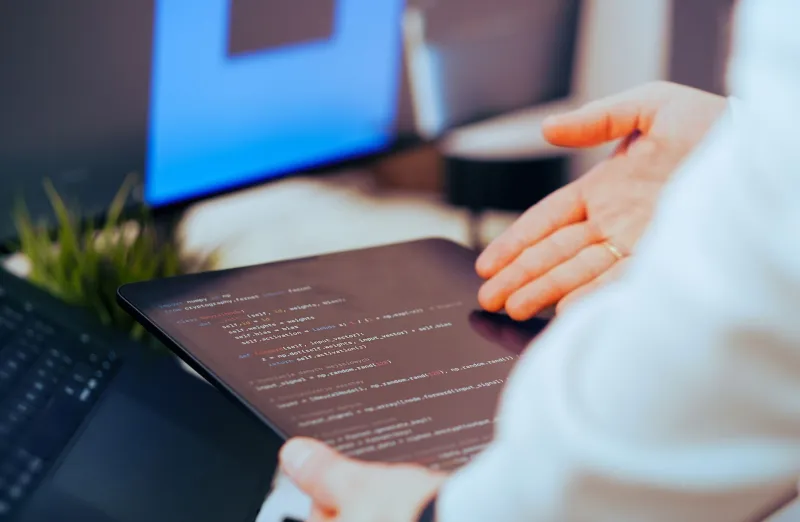
You've been staring at the same 30 lines of code for the better part of an hour. You've run it three times. You've read it top to bottom twice. It looks right. It feels right. Then your coworker leans over, reads it for maybe fifteen seconds, and goes, "Oh — your loop condition is off by one."
And there it is. Plain as day. You want to disappear into your chair.
This isn't a story about being bad at your job. It's a story about how your brain is fundamentally wired to betray you when you're reviewing your own work — and what you can actually do about it.
Your Brain Fills in What It Expects to See
When you write code, you're not just typing characters — you're encoding intent. Your brain builds a mental model of what the code is supposed to do, and that model is powerful enough to override what's actually on the screen.
Psychologists call this expectation bias. When you read something you authored, your brain autocorrects on the fly. It sees what you meant to write, not what you wrote. This is the same reason proofreading your own essays is so notoriously unreliable. Your mind knows the destination, so it skips the wrong turns.
A colleague reviewing the same code has no such map. They're reading it cold, following the logic as it actually exists — not as you intended it. That's not a superpower they have. It's a constraint you've lost.
The Ownership Problem
There's another layer here, and it's a little uncomfortable to admit: code ownership creates emotional investment. When you write something, a small part of your identity gets tied up in it. You want it to be good. You believe it's good. And that belief quietly nudges your attention away from the parts that might not be.
This isn't vanity — it's just how humans work. Research in cognitive psychology consistently shows that people evaluate their own work more favorably than equivalent work from others. In engineering, that bias doesn't just sting your ego — it ships bugs.
When someone else reviews your PR, they have no stake in it being correct. They're just reading code. That emotional neutrality is genuinely valuable, and it's something you literally cannot manufacture for yourself in the moment you wrote it.
Attention Narrows When You're Deep In It
There's also a focus problem. When you're heads-down solving a hard problem, your attention zooms in. You're thinking about the algorithm, the edge cases you already know about, the architecture decision you made three functions up. That tunnel vision is useful for building — and terrible for auditing.
Reviewers come in wide-angle. They're scanning for structure, for logic flow, for anything that looks off. They haven't been marinating in your specific mental context for two hours. That distance gives them a broader field of view, and broader field of view catches more bugs.
So What Do You Actually Do About It?
The good news is that none of this is permanent. You can manufacture some of the same conditions that make external review so effective. It takes a little discipline, but it works.
Put Time Between Writing and Reviewing
This is the simplest and most underrated trick: don't review your code immediately after writing it. Even 30 minutes of doing something else can meaningfully change how you read it. Overnight is better. Your brain partially clears the mental model, and you return to the code with slightly fresher eyes.
On a real deadline? Even a short break helps. Step away, grab coffee, answer some Slack messages. Give your brain a chance to stop filling in the gaps.
Change the Format
If you normally review code in your editor, try reading it in a diff view — or print it out if you're old-school about it. Changing the visual presentation disrupts the autopilot your brain slips into when looking at familiar content. It forces more deliberate reading.
A lot of engineers swear by reviewing their own PRs in the GitHub interface before submitting, specifically because it looks different from their IDE. Same code, different context, different catches.
Read It Out Loud
Yes, seriously. Reading code out loud forces you to process every token instead of skimming. Your brain can't skip ahead as easily when your mouth has to keep up. It feels awkward, but it surfaces a surprising number of issues — especially logical gaps and missing conditions that your eyes just glide over.
This is a cousin of rubber duck debugging, and it works for the same reason: externalizing the code forces slower, more deliberate processing.
Explain It Before You Review It
Before you sit down to review your own code, try explaining what it does to someone — or something. Walk through the logic out loud as if you're teaching it. When you hit a point where the explanation gets fuzzy or hand-wavy, that's usually where the bug lives.
This technique works because articulating logic surfaces assumptions. And assumptions are where bugs hide.
Use a Checklist
One of the reasons external reviewers catch things you miss is that they're not emotionally attached to any particular outcome. A checklist mimics that detachment. Instead of reading your code with the goal of confirming it's correct, work through a structured list of potential failure modes: off-by-one errors, null handling, input validation, error propagation, edge cases you know are common in your stack.
You're not asking "is this right?" — you're asking specific questions that don't have a built-in answer.
The Meta-Skill Here Is Perspective Shifting
All of these techniques share a common thread: they're trying to get you to read your own code like a stranger would. That's the actual skill. The more you practice deliberately stepping outside your own mental model, the better you get at it.
And here's the flip side: the same cognitive awareness that makes you a better self-reviewer also makes you a more empathetic code reviewer for others. When you understand why someone missed something in their own code, you stop reading their bugs as carelessness and start reading them as a very human cognitive limitation.
That's the kind of perspective that makes you a better collaborator — which, in a community built around developers working and learning together, is kind of the whole point.
Your bugs aren't evidence that you're a bad engineer. They're evidence that you're a human one. The trick is building habits that compensate for that — so the only person finding your mistakes is you.